
Website last updated: 10-6-2026
Home
Book & Film reviews
Competitions
Event
FSWL Merchandise
In Memoriam
Interviews
James Bond 007 collection
James Bond 007 films
James Bond 007 games
James Bond 007 literature
James Bond 007 news
James Bond 007 products
James Bond 007 shop
James Bond 007 stars
James Bond Fan Clubs
Swedish people in the James Bond franchise
The decision that changed Casino Royale: why poker replaced baccarat in James Bond's most iconic duel
By: Anders Frejdh
Published:
2026-04-14
2026-04-14
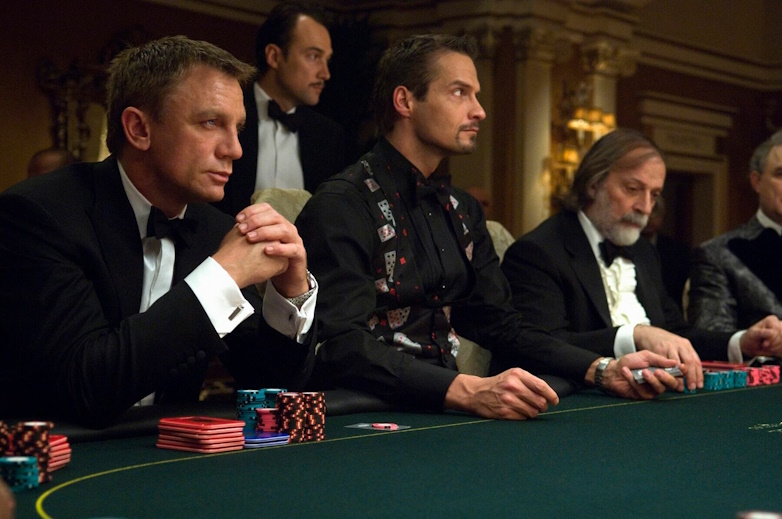
That choice may seem small, but it changed the power of the entire scene. Poker gave the film clearer conflicts, more readable tension, and stronger psychology. At the same time, the change reflected its own time, when poker had gained a real impact on a wide audience. Thus, the film encountered its own culture at the same moment.
That is precisely why the card duel feels like a key moment in the entire film. It tests not only Bond’s luck, but also his self-control. When the game is changed, the way we understand him also changes. It is an important clue to the entire reinterpretation.
When the card game controls the entire scene
The switch from baccarat to poker was no small detail. It affected the pace, imagery, and way of reading Bond as a character, but also how the audience could follow the game itself. The camera could stop at faces, chips and silences in a clearer way, even for viewers without deep knowledge of the game. It also gave the scene a better rhythm for cutting, close-ups and gradually increasing pressure.
Why the audience needed a clearer game
Baccarat carries a nice historical charge, but it is harder to read on film. Much is decided by the rules, and the drama often lies in the ritual around the table. This is especially noticeable when the mathematics of the game is to become emotion. For a modern cinema audience, it can feel more distant than nerve-wracking.
Poker was better suited to the time when the film was released, in the middle of the poker boom. In the years before the premiere, tournaments broadcast on television had made the game known far beyond casinos, and many had started playing poker themselves online. Many already understood words like “bluff” and “all in”. Therefore, the film was able to create tension without lengthy explanations.
The change has also made the film more sustainable in the long run. Online poker is still very popular, and today a large majority of gambling sites offer the game, as can be seen from a list of poker sites at Casinorino.se.
From the novel’s baccarat to the poker table
In Ian Fleming’s book, baccarat functions as part of the environment of luxury, control and old European style. The game fits the time when Bond was first created. The basic idea was still the same, a gambling table as a place for class, risk, power, and social control. When the film came much later, the same basis needed to speak to an audience with different habits.
Poker differs from baccarat in how it engages the player. The film uses the fact that poker is based on active decisions, reading opponents, strategic risks, and quick shifts in each hand. The difference was therefore largely in how much life the game gave to each glance and each pause.
The player chooses for himself when the pressure should increase through a new bet. The opponent’s gaze and body language become a visible part of the drama. New cards on the table immediately change the situation in front of the camera. In this way, the cards became part of Bond’s body language. Bond becomes more present when he has to choose.
The gaze became Bond's strongest weapon
Poker lets the camera live on faces. A raised bet can be followed by a still hand, an eye movement or an almost invisible smile. Such small signs become dramatic because the audience knows that someone can bluff.
It suited the new Bond that Daniel Craig introduced. This version is tough, but also more vulnerable and easier to read as a person. At the poker table, his coldness becomes not just style. It becomes a working tool.
The duel with Le Chiffre (Mads Mikkelsen) therefore functions as action without a car chase. Each pile of chips shows risk, pride and control. When the game swings, the power in the room also feels different. It gives the scene a physical charge even though almost no one moves.
It makes the table scene more than a stop between other action scenes. Here, the game becomes the very engine of Bond’s transformation. That’s why it stays in the memory.
A game change that says it all
Replacing baccarat with poker was not a violation of the novel for the sake of it. It was a way of translating Fleming’s idea into a cinematic language that suited its time and the film medium better. The same basis remained, a man who risks everything under pressure at a table where every choice is visible. But the expression became sharper.
Casino Royale shows how a small choice of detail can carry a whole new interpretation. Poker made the scene more visual, more psychological, and easier to share with an audience that already knew the signals of the game. It’s a small change with big consequences. In that very decision, Bond became modern without ceasing to be Bond.
Article by Anders Frejdh. Copyright © 2026 From Sweden with Love. All rights reserved.
Photo on top:
Daniel Craig as James Bond during the poker sequence in Casino Royale. Copyright © 2006 Danjaq LLC. & Metro-Goldwyn-Mayer (MGM). All rights reserved.
Tags:
#articles
#casino_royale
#daniel_craig
#james_bond_lifestyle
Tweet